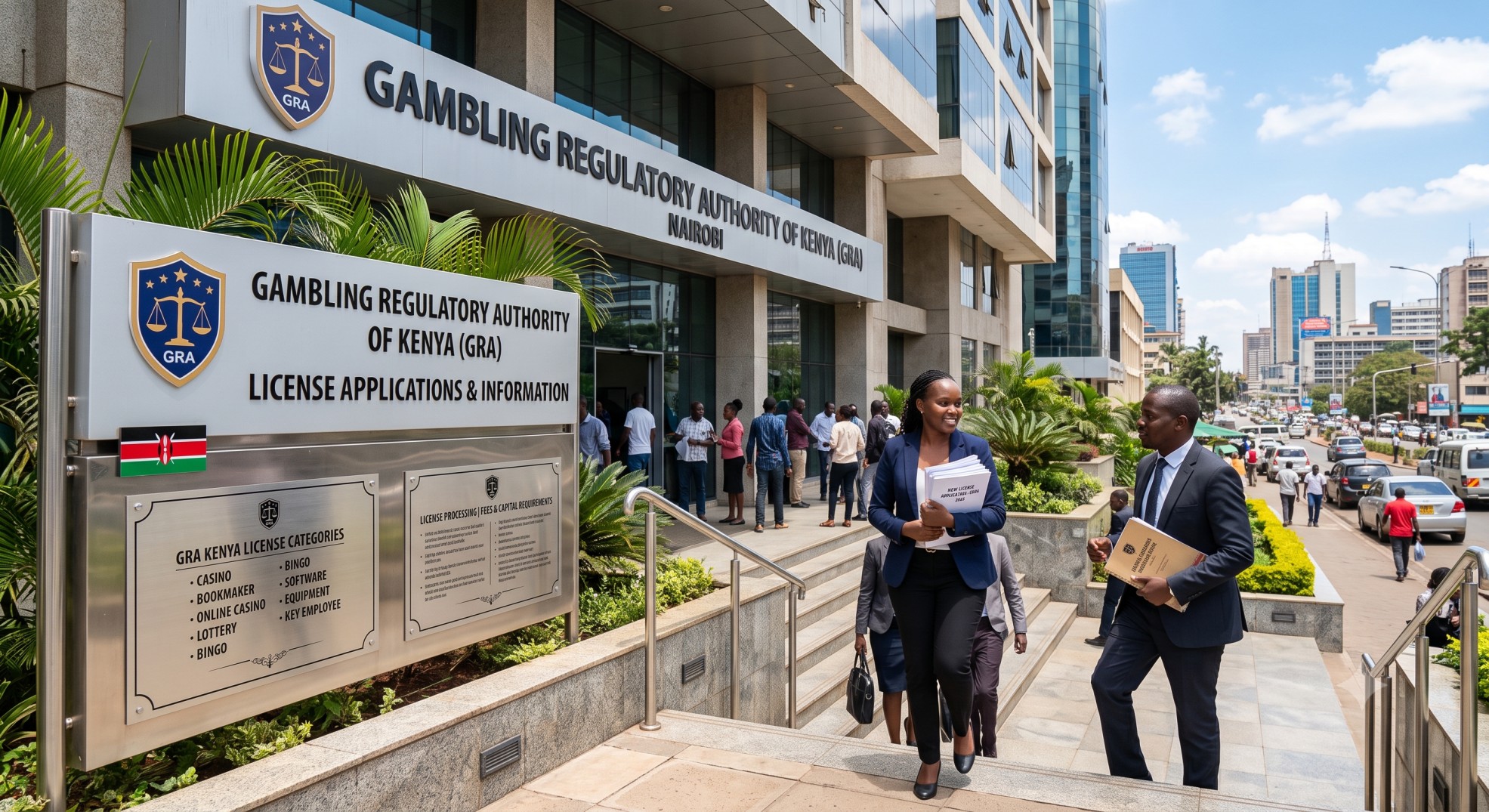
The gazettement of The Gambling Control(Licensing) Regulations marks a massive shift for the East African gaming market. Enacted under the Gambling Control Act, 2025, these new statutory rules completely overhaul how operators, tech vendors, and investors secure compliance.
Overseen by the Gambling Regulatory Authority of Kenya (GRA), the framework transitions the industry away from legacy frameworks into a highly specific, strictly enforced licensing regime.
Whether you are launching an online casino, a sports betting platform, or manufacturing gaming hardware, this comprehensive guide breaks down the essential licensing categories, application procedures, and financial compliance costs under the Gambling Regulations.
Complete List of the 15 GRA Kenya Gambling License Categories
Under the new framework outlined in Regulations, broad industry permits have been replaced by 15 distinct, standalone license types. Operators must hold exact authorizations for each vertical they touch:
Core Betting & Gaming Licenses
- Public Gambling License: Mandatory for land-based and online casino setups running slot machines or table games.
- Bookmaker Licenses: Separated into on-the-course (live race tracks) and off-the-course (betting shops), alongside a standalone Online Bookmaker License.
- Public Lottery Licenses: Divided into long-term public lotteries and short-term lotteries.
- Totalisators & Pool Betting Schemes: Dedicated regulatory approvals for pool-based wagering models.
- Prize Competitions & Media Promotions: Split by commercial versus non-commercial intent, alongside permits for cross-county media draws.
B2B Supply Chain & Tech Licenses
- Gambling Software or Platform Provider License.
- Gambling Equipment Manufacture or Assembling License.
- Gambling Equipment Sale, Distribution, or Importation License.
- Gambling Equipment Testing and Calibration License.
- Gambling Equipment Repair and Servicing License.
Key Gambling Employee License
- Individual vetting and approval is now mandatory for directors, executives, management personnel, shareholders holding voting rights, and designated Money Laundering Reporting Officers (MLROs).
Step-by-Step GRA Kenya License Application Process
Securing a license requires passing a meticulous corporate vetting pipeline conducted by the GRA Board Committee.
1. Corporate and Character Due Diligence
Every applicant must submit a deep paper trail verifying corporate transparency:
- Tax Compliance: Valid Kenya Revenue Authority (KRA) Tax Compliance Certificates and PIN certificates are mandatory for the business entity, all directors, and major shareholders. A current CR12 form is required for corporate structures.
- Criminal Background Checks: Certificates of Good Conduct from the Directorate of Criminal Investigations (DCI) must be attached for all key employees, directors, and shareholders. Foreign personnel must possess valid Kenyan work permits.
2. Regulatory System Integration
For digital operators (online casinos, lotteries, and sportsbooks), software infrastructure must explicitly feature API compatibility to sync directly with the GRA’s central management system for real-time monitoring.
3. Mandatory Governance and Compliance Policies
Applicants are legally required to attach finalized, comprehensive corporate policies covering:
- Anti-Money Laundering (AML/CFT): Internal systems for monitoring and counter-terrorist financing staff training.
- Responsible Gambling & Consumer Protection: Hardcoded tech controls including multi-tier age verification, player identity checks, deposit limit tools, reality-check session timers, and self-exclusion mechanisms.
- Data Protection & Dispute Resolution: Systems aligned with data privacy laws and structured local consumer grievance mechanisms.
4. Turnaround Timelines and Physical Audits
- Processing Time: The GRA reviews and alerts applicants within 14 days of an application, with final approvals or rejections concluded within 30 days of filing.
- On-Site Systems Inspection: Before authorization is granted, GRA officials inspect the operator’s physical premises to confirm information security, safety protocols, and absolute operational and technological separation from any sister or parent business holdings.
Financial Requirements: License Costs, Capital, and Fees
The financial barrier to entry has heightened under the Regulations. Operators must satisfy high capital minimums alongside non-refundable fees.
Minimum Gambling Capital Requirements
To maintain an active license, companies must prove they hold dedicated working capital reserves:
- Casinos (Online & Land-Based): KES 100,000,000
- Online Bookmakers: KES 100,000,000
- Land-Based Bookmakers: KES 50,000,000
- Public Lotteries (Long-Term): KES 150,000,000
- National Lottery: KES 2,000,000,000
GRA Statutory Fee Structure Breakdown
Fees are categorized by application, initial licensing, and recurring annual operation costs:
| License Category | Application Fee | Initial License Fee | Annual Operating Fee |
| Online Casino | KES 5,000,000 | KES 50,000,000 | KES 5,000,000 |
| Online Bookmaker | KES 5,000,000 | KES 50,000,000 | KES 5,000,000 |
| Land-Based Casino | KES 2,500,000 | KES 5,000,000 | KES 1,500,000 |
| Land-Based Bookmaker | KES 2,500,000 | KES 5,000,000 | KES 1,500,000 |
| Platform/Software Provider | KES 200,000 | KES 1,000,000 (Annual) | N/A |
| Gambling Marketing/Ads | KES 50,000 | 6% of total ad budget | N/A |
Key Enforcement Rule: All licensing fees paid to the GRA are completely non-transferable and non-refundable, and they cannot be adjusted on a pro-rata basis under any circumstance.
License Lifespans and Critical Enforcement Rules
- Duration of Licenses: Casino, bookmaking, and long-term public lottery permissions remain valid for 3 years. Online gambling, totalisators, bingo, technology supply, and key employee licenses require annual renewal.
- The 90-Day Renewal Deadline: Applications for license renewals must be filed with the GRA at least 90 days before your current license expires.
- Revocation Risks: The GRA retains strict statutory authority to suspend or completely revoke licenses if an operator fails to launch operations within 6 months of issuance, enters insolvency, breaches player data privacy, or fails mandatory regulatory compliance audits.
The 60-Day Grace Period for Legacy Operators
Brands actively running under the previous Betting, Lotteries and Gaming Act face a tight transitional timeline. Legacy licenses remain valid for only 60 days following the official publication of the Gambling Regulations. Operators must formally apply for their appropriate new license categories within this window or face full closure.
Legal and Regulatory Advisory for Gaming Operators
As the regulatory regime shifts, ensuring strict compliance is essential to protecting your business investment and avoiding heavy statutory penalties.
At Masibo Law LLP, we specialize in guiding international gaming operations, platform developers, and local stakeholders through complex regulatory transitions. Our expert team is available to manage your corporate gap analysis, structure application files for the new licenses, and liaise directly with the GRA during this transition phase.
In case you need more assistance you can reach us on info@masibolaw.co.ke
Leave a Reply